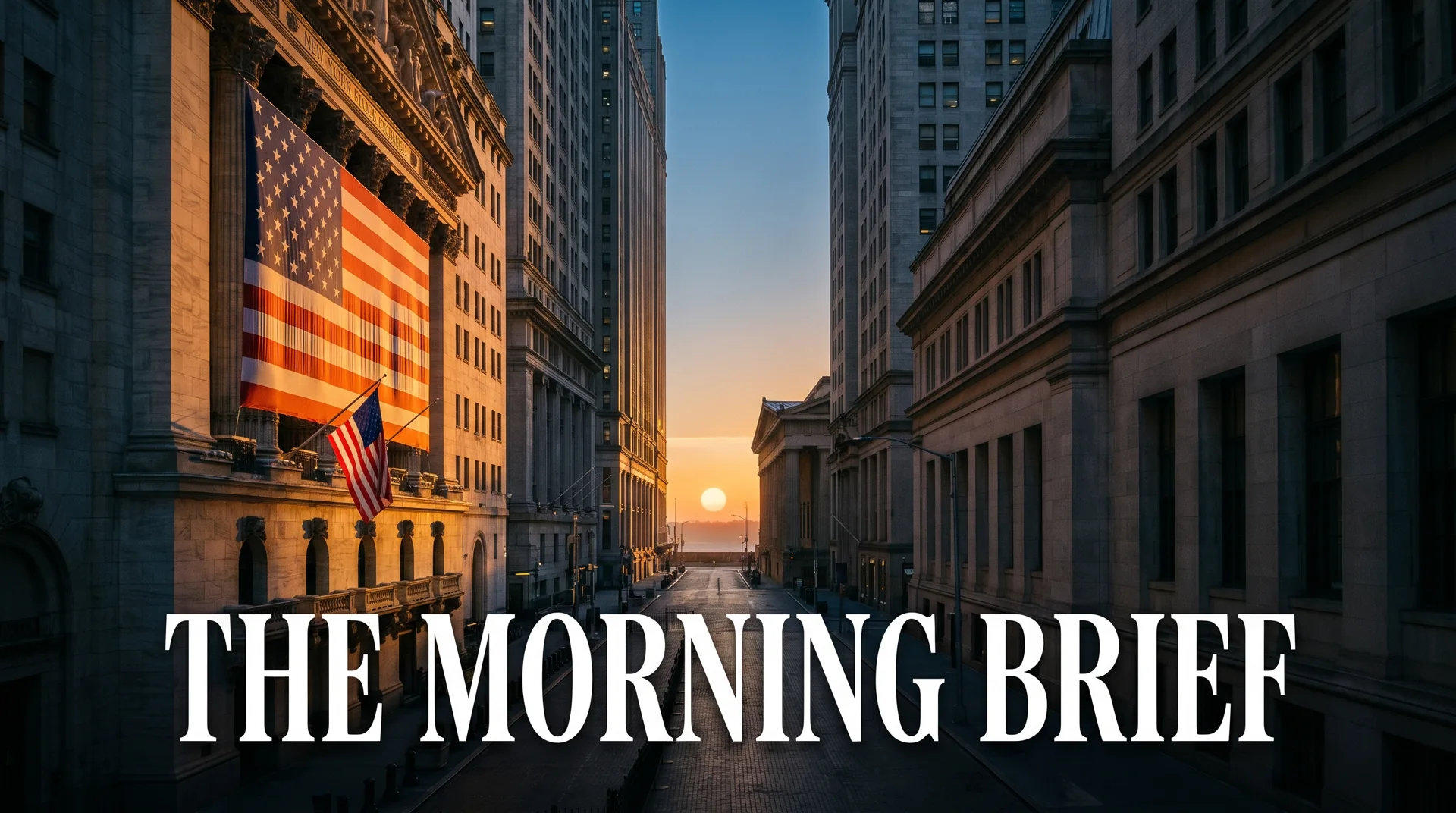
The Morning Brief
Futures are pointing lower, gold is taking its worst one-day hit in months, and Treasury yields are sitting at decades-high levels, and the spark overnight is geopolitical, not economic: traders are left deciding whether Washington and Tehran are actually headed toward confrontation or just posturing into the open.
Overnight, the tape is dominated by the Iran standoff and a mixed batch of Asia-Pacific data.
The Reserve Bank of Australia held its cash rate at 4.60%, in line with estimates but up sharply from 4.35% prior, a reminder that not every central bank overseas is easing. In Japan, Toyota (TM) reported August global production down 5.9% year over year and sales off 6.4%, a soft read on auto demand heading into the U.S. session. In Europe, Google (GOOGL, GOOGL) is contesting two EU orders it says would force it to open services and search data to rivals, keeping Brussels-versus-Big Tech tension alive. Layered on top: a Reuters exclusive shows Russia raising 2027 military spending by 27%, underscoring that the geopolitical backdrop remains hot well beyond the Gulf. On Iran, President Trump rejected Tehran's Hormuz proposal and dismissed talk of sanctions relief as a "hoax," while Iran's Supreme Leader warned the U.S. won't advance beyond the Arabian Sea. That combination knocked the Dow for a 300-plus point drop in the prior session and has S&P 500 (SPY) and Dow futures slipping again this morning, even as Nasdaq 100 (QQQ) futures manage a gain. Crude is firm, oil funds (USO) up on the tension. Bitcoin has given back some overnight strength but is still on pace for its best third quarter in a decade, up nearly 40% on the quarter.
Rates are the other story traders can't ignore.
Yields have pushed to levels not seen in decades, prompting Treasury Secretary Bessent to bring on Wall Street veteran David Zervos as an adviser, and drawing warnings from investors like Ross Gerber that bond volatility is flashing signals reminiscent of 2008. Long bonds (TLT) and gold (GLD) are both under pressure, an unusual pairing that speaks to real stress in the rates complex rather than a simple flight to safety.
AI remains the market's central narrative, even amid the risk-off tone.
Reuters reports Anthropic's IPO prospectus shows a "sweeping AI vision" alongside surging costs, while the WSJ says OpenAI scrapped a new model release over safety concerns. AMD is buying AI firm World Labs in an $8.2 billion deal, and Nvidia (NVDA) is reportedly turning to insurers to spread AI build-out risk, per the FT. Politically, the sector is under a brighter spotlight: Trump is hosting Zuckerberg, Huang, Amodei and Brockman for an AI lunch in Washington, Congress is debating new AI safety legislation, and the Pope weighed in critically on Huang's deregulatory stance. Meta (META) faces fresh scrutiny after a Hunterbrook report claims its Muse AI can identify and profile real people, a headline risk worth watching given the stock's already sizable pullback.
Single-stock movers:
CarMax (KMX) beat handily on both earnings and sales ahead of the open. AAR (AIR) beat estimates and announced a roughly $1.8 billion deal for a majority stake in MRO Holdings, funded with debt, equity and a PIPE, though shares are lower as investors digest the dilution. Navitas Semiconductor (NVTS) is higher premarket after winning a U.S. government contract to develop next-generation silicon carbide power semiconductors. Goldman Sachs (GS) is in focus on reports its board has discussed a CEO transition, with John Waldron eventually succeeding David Solomon.
On the radar today:
Carnival (CCL), Concentrix (CNXC) and Uranium Energy (UEC) round out the earnings slate alongside AIR and KMX. Watch Hormuz headlines and yield moves for direction into the open.
Bottom line: geopolitics and yields are driving the tape this morning, and until Iran risk and rates stabilize, AI headlines will have to fight for the market's attention.